Put It Back · Puzzle
A small scene. A closer look.
Put It Back turns a familiar tabletop into a memory puzzle. Look at eight objects for ten seconds. When three disappear, return them to the places you remember. The interaction is small; the details give you something to notice.
Play Put It Back cognitivetest.com (opens in a new tab)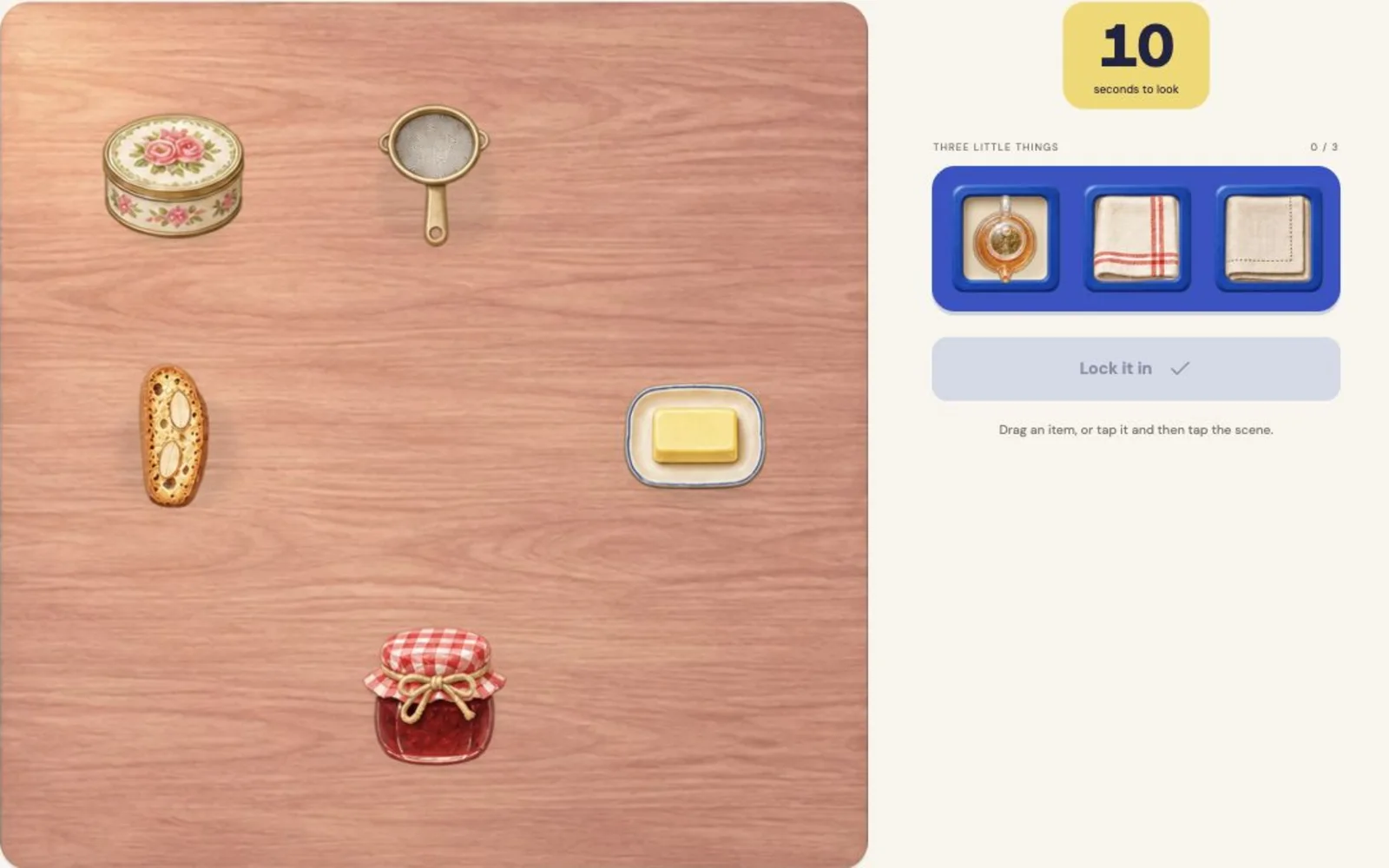
Observe briefly. Place at your own pace.
The ten-second observation phase gives every round a clear beginning. Once the objects disappear, placement is untimed. You can compare their relationships, reconsider a position, and make small adjustments before submitting. Time is recorded, but it does not change points or ranking.
Each of the three returning objects can earn up to 100 points, for a maximum of 300 per round. The result shows how close each placement came to the original. This makes a near miss something you can inspect, rather than only a number at the end of a game.
Difficulty changes what you remember
Easy uses eight fixed positions, giving the scene a clear spatial structure. Medium distributes objects in more natural arrangements. Hard adds orientation: remembering which way an object faced becomes part of the task as well as remembering where it stood.
In Hard mode, position and rotation each contribute up to half an object’s score. Objects whose rotation is visually ambiguous are excluded as targets. For suitable artwork, the scoring also accounts for symmetry, so an equivalent orientation is treated consistently.
Illustration meets precise interaction
The scene collection spans everyday settings with distinct surfaces and individual object artwork. Placement keeps enough separation between items to make each one identifiable. These are visual compositions as well as puzzles: the relationships between objects are what players study.
Mouse and touch players can drag objects or tap to place them. Keyboard controls and fine nudges support smaller adjustments, while Hard mode adds a rotation handle and angle controls. The illustrated board remains the focus across these different input methods.
A daily ritual or a longer visit
Daily Challenge offers three scenes each day, with separate results for each difficulty. Solo Play opens a collection of 100 scenes and ten-round series. Friend challenges preserve a particular puzzle so another player can attempt the same arrangement before comparing results.
The appeal comes from looking closely, remembering a few details, and returning to a familiar scene with a fresh arrangement. A round can stand on its own, while the different scenes and difficulty settings offer more to explore.
READY TO PLAY?